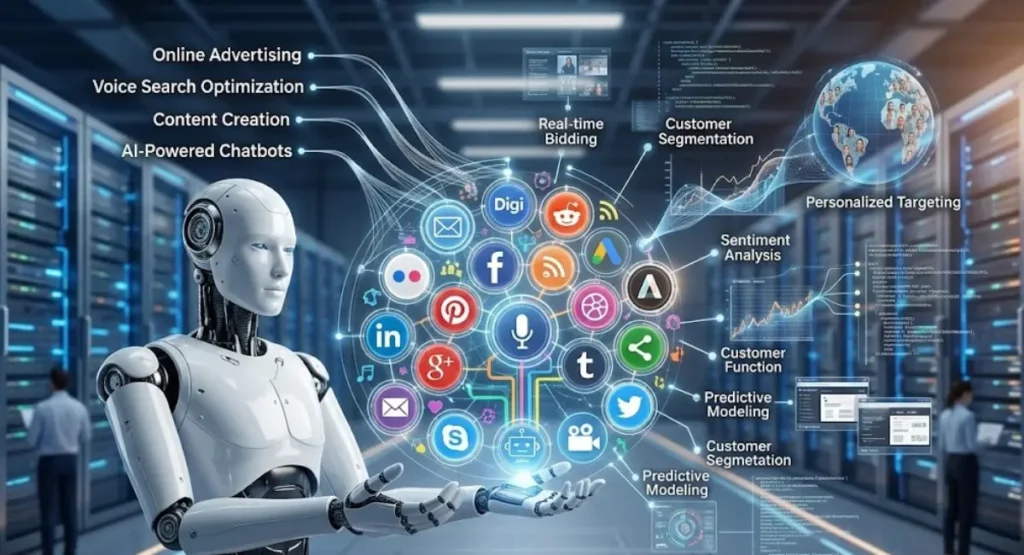
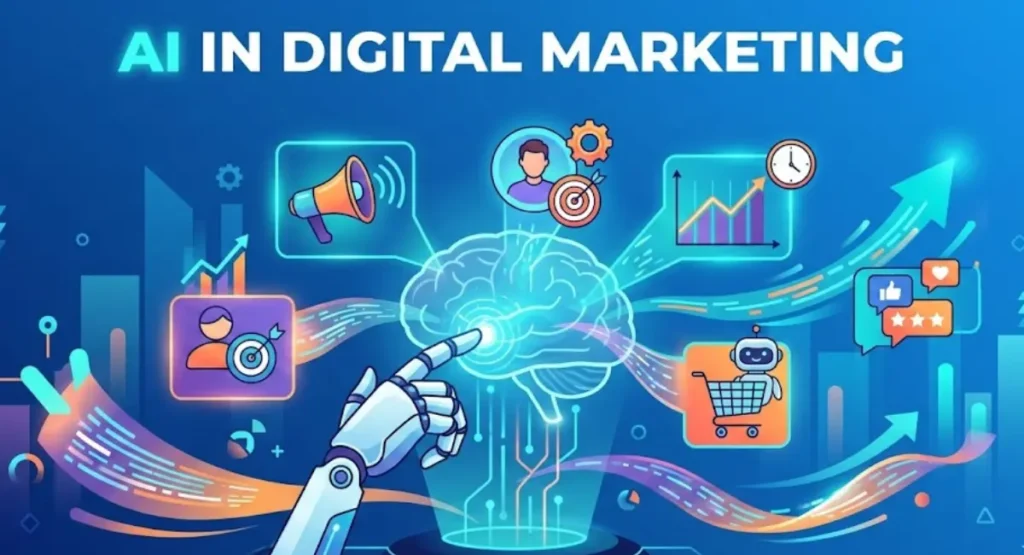
AI in digital marketing
Today, AI in digital marketing is the driving force behind the most successful brands online. From predictive targeting and smart ads to personalized customer journeys and automated content creation, AI has completely changed how marketing works.
Companies that still rely on traditional, manual strategies are already falling behind.
Meanwhile, businesses using AI are:
- Increasing conversions by 2–5x
- Reducing ad costs
- Automating repetitive tasks
- Delivering hyper-personalized experiences
- Making smarter decisions using real-time data
In simple words: AI helps marketers work smarter, not harder.
In this comprehensive guide, you’ll learn:
- What AI in digital marketing really means
- How it works behind the scenes
- Benefits and real-world use cases
- Practical tools and strategies
- Step-by-step implementation
- Future trends
- How Host2Unlimited uses AI to scale brands
If you want to dominate search rankings, ads, and customer engagement in 2026 and beyond, this guide is for you.
What is AI in Digital Marketing?
AI in digital marketing refers to using technologies like:
- Machine Learning
- Predictive Analytics
- Natural Language Processing
- Automation
- Big Data Intelligence
to improve marketing performance automatically.
Instead of guessing what customers want, AI:
- Collects user behavior data
- Analyzes patterns
- Predicts outcomes
- Automates decisions
This allows brands to deliver the right message to the right person at the right time — without manual effort.
Simple Example
Without AI:
You show the same ad to everyone.
With AI:
Each visitor sees a different ad based on their interests, behavior, and purchase intent.
That’s the power of intelligent marketing.
Why AI is Transforming Digital Marketing
Digital marketing used to depend on:
- Assumptions
- Manual testing
- Broad targeting
- Delayed reporting
This often resulted in wasted budget and low ROI.
AI changed everything by introducing:
Data-driven decisions
No more guesswork.
Real-time optimization
Campaigns improve automatically.
Personalization at scale
Millions of users can get unique experiences.
Faster execution
Tasks that took weeks now take minutes.
Because of this, AI is no longer optional — it’s essential for growth.
Core Benefits of AI in Digital Marketing
Let’s break down the biggest advantages.
1. Hyper-Personalization
Modern customers expect personalized experiences.
AI analyzes:
- Browsing history
- Purchases
- Click behavior
- Location
- Interests
Then delivers tailored:
- Emails
- Ads
- Recommendations
- Offers
Result: Higher engagement + higher conversions.
2. Predictive Analytics
AI doesn’t just analyze the past — it predicts the future.
It can forecast:
- Who is likely to buy
- Which leads will convert
- When users will churn
- What products will sell?
This helps marketers focus only on high-value opportunities.
3. Marketing Automation
AI automates repetitive tasks such as:
- Email sequences
- Ad bidding
- Lead scoring
- Chat responses
- Content scheduling
This saves hundreds of hours monthly.
Your team focuses on strategy while AI handles execution.
4. Smarter Advertising
AI-powered ad platforms automatically:
- Adjust bids
- Pause poor ads
- Scale winning ads
- Test creatives
- Target high-converting audiences
This reduces wasted ad spend and increases ROI.
5. Better Customer Experience
AI chatbots and support systems provide:
- Instant replies
- 24/7 service
- Faster problem resolution
Customers get help immediately — not hours later.
Happy customers = more sales.
How AI Works in Digital Marketing (Step-by-Step)
Understanding the process helps you implement it better.
Step 1 – Data Collection
AI gathers data from:
- Websites
- Ads
- CRM
- Emails
- Social media
Step 2 – Pattern Analysis
Machine learning finds trends and behaviors.
Step 3 – Prediction
AI forecasts likely outcomes.
Step 4 – Automation
Systems act automatically based on predictions.
Step 5 – Continuous Learning
AI improves with more data over time.
This creates a self-optimizing marketing system.
Applications of AI in Digital Marketing
Here’s where AI is making the biggest impact.
AI in SEO
Search Engine Optimization is becoming increasingly data-heavy.
AI helps by:
- Finding keyword opportunities
- Clustering topics
- Analyzing competitors
- Predicting rankings
- Optimizing content structure
- Generating content ideas
Marketers can now rank faster with smarter strategies.
AI in Content Marketing
Content creation becomes easier with AI assistance.
It supports:
- Blog outlines
- Headlines
- Email copy
- Social posts
- Product descriptions
- Video scripts
This speeds up content production without losing quality.
AI in PPC Advertising
Paid ads benefit hugely from AI.
AI handles:
- Smart bidding
- Audience targeting
- Creative testing
- Budget allocation
- Conversion optimization
Result: More results at lower cost.
AI in Email Marketing
AI improves:
- Send time
- Subject lines
- Segmentation
- Personalization
- Automated flows
Emails feel relevant, not spammy.
AI in Social Media Marketing
AI tools can:
- Suggest trending topics
- Auto-schedule posts
- Analyze sentiment
- Predict engagement
- Recommend the best posting times
This helps brands stay consistent and relevant.
AI in E-commerce
Online stores use AI for:
- Product recommendations
- Dynamic pricing
- Cart recovery
- Customer segmentation
- Demand forecasting
This increases average order value and repeat purchases.
Real-World Use Cases of AI Marketing
Let’s look at practical examples.
Case 1 – E-commerce Store
AI recommendations increase cross-selling → 30% higher revenue.
Case 2 – SaaS Business
AI lead scoring improves sales targeting → 40% more conversions.
Case 3 – Local Service Business
AI chatbots handle inquiries → 24/7 lead capture.
Case 4 – Marketing Agency
Data automation reduces manual work → faster client growth.
Challenges of AI in Digital Marketing
AI is powerful, but not perfect.
Here are common obstacles:
Data quality issues
Bad data leads to wrong decisions.
Tool complexity
Learning curves exist.
Costs
Advanced platforms can be expensive.
Privacy regulations
Compliance with GDPR and data laws is essential.
Over-automation
Too much automation can reduce human touch.
Solution
Start small, test gradually, and scale smartly.
Step-by-Step Implementation Plan
Here’s a simple roadmap.
Phase 1 – Foundation
- Define goals
- Install analytics
- Collect clean data
Phase 2 – Start Small
- Chatbots
- Email automation
- Smart ads
Phase 3 – Expand
- Predictive analytics
- AI SEO tools
- Content automation
Phase 4 – Optimize
- Track KPIs
- Test continuously
- Scale winners
Consistency beats complexity.
The Future of AI in Digital Marketing
By 2026–2030, expect:
- Fully automated campaigns
- AI-generated videos
- Voice search dominance
- Real-time personalization
- Predictive customer journeys
- Zero manual bidding
Marketing will become more intelligent and less manual.
Early adopters will dominate.
Late adopters will struggle.
Why Businesses Need AI Today
If competitors use AI and you don’t:
They will:
- Target better
- Convert faster
- Spend less
- Rank higher
You’ll lose market share.
AI is now a necessity — not an advantage.
How Host2Unlimited Uses AI to Drive Results
At Host2Unlimited, AI is integrated into every marketing strategy.
We combine:
- AI SEO research
- Smart ad optimization
- Predictive lead scoring
- Automated funnels
- Data analytics
- Conversion tracking
Our approach:
Analyze → Predict → Automate → Optimize → Scale
This ensures:
✔ Faster growth
✔ Lower costs
✔ Higher ROI
✔ Sustainable results
We don’t rely on guesswork. We rely on intelligence.
Frequently Asked Questions
What is AI in digital marketing?
AI in digital marketing uses machine learning and automation to analyze customer behavior and improve campaigns automatically.
How does AI improve marketing results?
AI increases personalization, reduces costs, predicts customer actions, and automates repetitive tasks.
Is AI replacing marketers?
No. AI assists marketers. Strategy and creativity still require humans.
Can small businesses use AI?
Yes. Even basic tools like chatbots and email automation deliver strong results.
Is AI marketing expensive?
Many tools are affordable. Start small and scale as ROI grows.
Read also – Digital Marketing Mistakes, Why Need Digital Marketing in 2026